Tuesday, March 12, 2019

THE LAND OF THE SANGHAI

May 2016

It takes a lot of heart to plan your first official birding trip to Manipur. But plan we did, thanks to the Centre for Conservation of Nature and Cultivation of Science (CCNCS), Manipur led by Mr. Birjit, IBCN State Co-ordinator who did a wonderful job planning the logistics in a place that is not completely geared to entertain tourists. This was Mrugaya Xpeditions first official birding tour and that we took the risk of planning a trip to Manipur was to some extent a result of the participants we had. Piran Elavia is no novice to the North-East, Delwyn Dsouza was up for the challenge of the unexpected, Satish did not mind any difficulties as long as he could see birds and Marvelyn, the only lady, is tougher than any of the males in the group and could smile through any difficult situation.

Our original itinerary went for a toss thanks to the Bandhs, rains and landslides that we encountered. So much so that one of the site, Dailong in Tamenglong district had to be completed skipped. But that is what NE is all about. Be prepared for the unexpected. The rains also disturbed our rythm and if rains did not the fog did. The weather Gods were surely not on our side but we made up for all these with the birds that we sighted. I can just imagine how it could have been if we had encountered clear weather.The first two days were spent at the Keibul Lamjao National Park (KLNP) commonly referred to as the Loktak Lake. The Eurasian Cuckoo and the Common Hawk Cuckoo called from all directions. It is at Loktak that we had good sightings and photography opportunities of the Rufous-necked Laughingthrush, Slender-billed Babblers, Straited Grassbird, Yelllow Bittern, White-tailed Stonechat, Lesser Coucal, Burmese Shrike, Yellow-bellied Prinia and the Jerdon’s Bushchat.From Loktak we travelled to Sirui. Roadside birding yielded the Black-Francolin, Crested Bunting, Scarlet Minivet, Chestnut Munia etc. Rains followed us wherever we went. But that did not dampen our spirits though photography was huge challenge. 


We encountered some interesting species while birding around Sirui especially three species of Yuhinas (Straited, Whiskered & Stripe-throated), Yellow-bellied Fantail, Blue-winged Siva, Red-tailed Minla, Green-tailed Sunbird, Mrs. Gould’s Sunbird, Nepal Fulvetta, Slaty-headed Parakeet, Spot-breasted Scimitar Babbler etc. Satish had his eyes on Mrs. Hume’s Pheasant and managed to persuade a local hunter to take us deeper into the forests in search of the illusive lady. While, Piran & Delwyn decided to trek up the Sirui hill to get a glimpse of the endemic Sirui Lily, the remaining three of us followed the newly established contact into the forests of Sirui. The thick canopy, uphill climbing made things difficult but we did manage to sight quite a few birds that included the Streaked Spiderhunter, Nepal Fulvetta, Chestnut-vented Nuthatch, Black-throated Tit etc. The highlight for me was the Little Pied Flycatcher that we managed to trace from its call. What a handsome fella!!


Since Dailong had to be cancelled, Birjit suggested we go further deeper into the forests to a village called Phuba. We agreed since there was no other option. The forest on the road to Phuba was a revelation. I had just heard, read and made a mental picture of evergreen forests with huge trees, their branches laden with moss, fog engulfing them and one hearing calls but seeing nothing. That day we experienced it and no words or a picture can do justice to the spectacle. Though as birders not getting to see the Pygmy Wren Babbler when it’s calling from the bushes nearby or seeing the Slaty-blue Flycatcher perched but not getting a decent picture due to the overcast conditions was a slight dampener. The Rufous-vented Laughingthrush too kept on calling from the undergrowth but refused to give us a glimpse. One day at Phuba was completely washed out due to heavy rains and the road that we travelled on needed a four-wheel drive to get us out. So much for an adventure. 

But the birds did not disappoint. Some of the highlights were the Golden Babbler, Grey Sibia, Slaty-backed Forktail, Crested Finchbill, Striated Bulbul, Flavescent Bulbul, Ashy Bulbul, Lemon-rumped Warbler, Grey-hooded Warbler, Chestnut-crowned Warbler, White-browed Laughingthrush, Rusty-fronted Barwing, Rufous-bellied Niltava, Golden-throated Barbet, Blue-throated Barbet, Crimson-breasted Woodpecker etc. The most intriguing was the Mountain Tailorbird. This bird has a melodious song that had us intrigued for a long time until we had a good sighting of it. The White-throated Fantail too was nothing like we had seen before, with only a small collar instead of the complete white throat that we are used to seeing.


All in all a wonderful trip with 127 species sighted inspite of the inclement weather. The State Bird of Manipur though has eluded us and it will be the magnet that will attract us back to the forests of Manipur in the future

Wednesday, February 27, 2019

HOW I HAPPENED TO BE A BIRDER


Date: January 24, 2011

I was lying on an armchair in the courtyard outside Nitesh’s house in Vengurla after a sumptuous lunch of rice and prawns curry. The courtyard had a huge mango tree and a couple of chikoo trees under whose shade I was resting. Overhead I could hear a continuous pook-pook call resonating from the canopy. I had heard this call before on a number of occasions but could never find the source however hard I tried. Enquiries with friends also did not help. I had no intentions of trying this time around especially after the heavy meal. Suddenly a movement in the tree caught my attention. Something moved near a small hole in one of the branches. The hole was a perfect circle with clean chiseled sides. A yellowish black face with vermilion smeared on its head peered outside. The pook-pook call started emanating from this beautiful bird while it bobbed its head and puffed out its throat at every bob. I was awestruck by the beauty of the bird and intrigued by its identity. It would be nearly a year from that event that I would eventually put a name to the bird - the Coppersmith Barbet (Megalaima haemacephala)- but the seed of observing birds was sown then.


Another bird that triggered my curiosity was the Common Iora (Aegithina tiphia). The long extended whistle like call was amusingly attributed to the Rat Snake (Ptyas mucosus) thanks to the stories made up by Babi Gawde in Amboli. I always wondered at what the snake does in the canopy but never in my dreams thought that it could be a bird. It was in Amboli that I finally saw the male perched on a twig of Anjan (Memecylon umbellatum) tree and calling blissfully unaware of my presence, that realization struck.


There have been many such occasions, when ignorance has taken the better of me, such as every bird that was white would be an Egret. It was only in 1996 while on a holiday from college, I was spending time in Goa and my father realizing my interest in birds decided to show me a book on birds which was lying unused in the college he taught. The book, which was never used since it was bought by the college, turned out to be the Handbook on Birds of the Indian Subcontinent – the compact edition and which I would learn later, is every birder’s envy and a collector’s item. It was while surfing through the pages of this book, I learnt that we in Goa have 7 different species of Egrets. It was time now to give names to all those birds I had seen and observed, shot and eaten. As a youngster, I have committed the crime of shooting birds for the pot but which I comprehend allowed me to have a close and upfront look at them. This book has been my trusted companion over years and even today when a certain Warbler causes identification problem, I turn to the Handbook for help. Though inbetween the pockets guides by Salim Ali, Inskipp and Grimmet have been companions on the field, the Handbook always has its special place in my cabinet.

Within no time my tally of birds grew and I was enjoying every moment of the time spent in the field. Every day a new bird name was being discovered. Nothing can compare the joy of going out into the field looking for birds, merging with the surrounding, getting as close and possible, observing without a binocular, making notes on various characters, scribble line-drawings and then spending the next day looking for the names in the book.

It was only in 2000 that I finally had my own binocular. But the story of acquiring it has to be told. My association with the WWF-Goa Chapter was taking me places in Goa and my skills as an upcoming birder were being tested. The period of “no binocular” had made me pretty adept at putting names to the bird calls since visibility is much restricted. One day I received a call from Hotel Cidade-de-Goa requesting me to speak to a guest who was a birder. Mr. Roy Crosby from Yorkshire was given my contact from the WWF office. Having difficulty communicating with him over the phone I volunteered to visit him in the hotel and take it forward. I rode our old but trusted Vijay Super scooter to the hotel to meet Mr. Crosby seated in the lobby. The sight of a 64 year old man with a many pocketed jacket and armed with binoculars, spotting scopes and bird books intimidated me. On interacting I realized that the gentleman knew much more than I did and it was no point wasting his time. Hence, after saying exactly that, I started back home. Half way down the road a thought struck me. If I accompanied him to the field, I would get to learn. Turning back to the hotel, I called upon him and expressed my feelings. Fortunately, he not only agreed but appreciated my eagerness to learn. We went out to the field regularly for the entire week to varied habitats from forests to wetlands. The spotting scopes were a revelation at the Carambolim wetlands, where I got to observe the waterfowls very closely and what seemed to be at a hands distance. My presence around Mr. Crosby was not entirely useless though, since my skills with bird calls helped him locate birds in the forests. Mr. Crosby returned to England, probably a satisfied man but not before promising to send an old pair of binoculars with his friend Mr. Dickie Bird, who was visiting Goa in a couple of months time. Thanking him for thinking about it, I forgot the episode only to be surprised one afternoon by a call from none other than Mr. Bird. I met him at Hotel Beira Mar in Baga where he presented me with my first binocular a heavy, metal 8-15x40. I was thrilled. Thrilled is an understatement, I was ecstatic. On the request of Mr. & Mrs. Bird, I accompanied them on their field visits, who before returning back home gifted me the Birds of the Indian Subcontinent by Salim Ali on my birthday. Mr. Crosby would return back for the next two seasons before health forbid him travel and I would join him on his birding forays. The enthusiasm to spread knowledge to the younger generation took its toll on the binocular and in due course of time was replaced by a lighter Olympus 8x40 but I have always treasured my first one and put it away safely in the cabinet as a reminder of those earlier days and ofcourse, Mr. Roy Crosby.


There have been people who have moulded by birding journey. If not for my father and his encouragement to observe the denizens of the forest and then the bird book, I would have been groping in the dark. Mr. Crosby and Mr. Bird who gifted me the binocular and the bird book respectively. Gordon Frost, who unassumingly helped a local boy interested in birds to look more closely at waterfowls. If not for him, it would have taken me years to sort out the difference between females and juvenile males of waterfowls. Nitesh Parulekar who tagged along during my field visits has an excellent eye for birds and behavior observation. Carl D’Silva taught me the finer details of ringing, taxidermy and provided unstinting support at every step. Heinz Lainer whose Birds of Goa was a huge motivator to document further. Pankaj Lad infects me with his zeal of single mindedly following his dream of taking up birding as his career.


Being a member and then the State Co-ordinator for the Indian Bird Conservation Network (IBCN) brought me touch with the likes of Dr. Asad Rahmani, Dr. Subramanya, Dr. P.O. Nameer, Dr. Priya Davidar, Dr. Anwaruddin Choudhary, Rajat Bhargava, Ian Barber from the RSPB, Adesh Shivkar, Raju Kasambe, all excellent birders who added to my knowledge on avian fauna. My association with these people gave me greater impetus to focus on scientific documentation and conservation. The reporting of the White-naped Woodpecker (Chrysocolaptes festivus), the Spotted Creeper (Salpornis spilonotus), Streaked Weaver (Ploceus manyar) and the Slaty-legged Crake (Rallina eurizonoides) for the first time from the State of Goa are fallout of this association.


I have moved on to studying insects, especially Odonates, but I owe my entry into the wildlife circuit to birds and cannot help myself focus my binoculars into the tree canopy or on a hunting party with a hope to spot a “lifer” everytime I move into the jungle.

Monday, June 15, 2015

IN SEARCH OF VULTURES
                                                                                                  Date: November 09, 2012

Dr. Asad Rahmani, the Director of BNHS, spoke vehemently about the status of the vultures in the country and the need to conserve their last known abodes. It was the winter of 2005 in the workshop of the Indian Bird Conservation Network in Mollem, Goa. We listened with apt attention and focus to what he had to say. At the back of my mind, the image of vultures gliding over the Goa Meat Complex courtyard in Usgao was vivid and I understood why we did not see them anymore. A small intervention by man in the form of a veterinary drug-diclofenac-had spelt doom for these majestic masters of the skies.

I and Pankaj had also documented a colony of nesting Long-billed Vultures (Gyps indicus) in the Chorla Ghat on the border of 3 states of Maharashtra, Goa and Karnataka. These vultures nested on the cliff from where the imposing twin-waterfalls of Vajrasakala cascaded down. The only vantage point to observe them was the opposite cliff way beyond the reach of any binocular or spotting-scope. The white dropping of the birds on the cliff rocks was the only evidence of their nesting. The only way to know for sure the number of active nests was to trek to the top of the waterfall and get a closer look.

Finally the day arrived when I, Pankaj, Nitesh and Sanket decided to enter the gorge of the River Valvanti, the source of the twin waterfall. Early morning we set out for what was to be the toughest trek of my life and one in which we risked limbs and lives to get up & close to the nesting vultures.

The entire trek was through the river bed, negotiating water pools, slippery rocks, steep slopes and deep gorges. Some were so tricky that a slip would end up with broken limbs and in a manner for nobody to help you. All this negotiating was done without any formal training of rock climbing or availability of gear. Our expedition was based on sheer resolve and the only encouragement was to count the number of active nests.

Over 2 ½ hours of arduous trek brought us to the last leg of our journey to the top of the waterfall. We realized that our best bet to observe the nesting vultures would be to get on to the ledge jutting out between the two waterfalls. To accomplish this we had to navigate a 1000 foot drop to the base of waterfall and a deep gorge. How we managed to do it God alone knows and the plants of Karvi (Carvia callosa) which provided us the much need support to hold on to our dear lives.

But once on the ledge, the scene was spectacular. The landscape below was breathtaking and the cool breeze rejuvenated our spirits. Vultures glided below effortlessly and it was for the first time that I actually observed these giants glide below us. Some were collecting nesting material for a total of 4 nests that we counted and a total of 12 birds.

The journey back was equally strenuous and at points we actually got to all our fours or clung on to rock faces. By the time we reached the Wilderness Resort, from where we had begun our journey, we were physically exhausted but our emotional state was one of triumph. Every bone and muscle in our body longed for rest and replenishment. That we had to travel another 70 odd kilometers to get back home on our 2-wheelers was not a very pleasant thought.

That night as I & Nitesh slept in the comfort of our home, I experienced hallucinations for the first and the last time in my life. I had illusions of falling from the cliffs, slipping over rocks, missing my step and each time that happened I was rudely awakened from sleep. Though my body longed to sleep my sub-conscious was still wandering in the gorge of the Valvanti. The next morning I narrated my experience to Nitesh, who had a hearty laugh but not before admitting that he too had similar illusions.

We followed this colony for over 4 years. Every monsoons they would migrate to escape the heavy monsoons in the Ghats and arrive back at the end of monsoons to start nesting. Every year their numbers dropped till 2009 when only one individual was sighted. This data was shared with BNHS and Peregrine Fund hoping for some conservation action on ground. No sign of the colony or any individual since has been seen in the locality. We only hope against hope that they have found a better place to breed and not met the fate that 99% of vultures all over the sub-continent have met.


I & Nitesh meanwhile documented 3 more colonies, one of White-backed Vultures (Gyps benghalensis) and 2 of Long-billed Vultures in various parts of the neighbouring district of Sindhudurg in Maharashtra. Goa on the other hand has lost all its vultures and every time I see the Vajrasakala Waterfall, I am reminded about the last vultures that we could call our own. 

Monday, December 30, 2013

THE VANARMARE: HUNTERS PAR EXCELLENCE

My love for the wild finds its origin in Amboli village where I not only got to see and experience wild animals up-close but various communities especially the Dhangars and the Vanarmare. While my thoughts on that one special Dhangar, whom I and my sibling grew to love, will be penned later, for the present read my article on the Vanarmare tribes. Pity that I did not carry a camera then.
http://www.tambdimati.com/article/amboli-all-those-years-ago/

The article was written on January 28, 2011 and the questions asked at the end, have come true. My colleague Dr. Sachin Tendulkar is trying his best to help a tribe back here in Goa. Check this link and support in any way you can. https://www.facebook.com/tendulkar1/media_set?set=a.10202896953010778.1073741830.1411128011&type=1 

Monday, July 22, 2013

WHAT NEXT!! .... An Environment & Development dilemma


This poem is a representation of the dilemma I face when confronted with issues of Environment & Development.


WHAT NEXT!!

It was a pleasant Friday morning

The bright sun shining

Into the city I walked

Unmindful of the killer that stalked

Axe after axe fell on the tree

Save me! Save me! cried the tree

I was hurt, I was outraged

Within no time the tree would bite the dust

And I stood there, wondering what next!!


Appeared a wise man to speak for the tree

Doesn’t it have the right to live free?

It provides you food, clothing and shelter

Without which you would be a pauper

Convinced appeared the woodcutter
But said I have to wield the axe for survival
Today morning someone lost his father
If it is not this tree, it would be some other
I still stood there as the woodcutter left
Wondering what next!!

Wednesday, September 26, 2012

CREATING FOOT SOLDIERS


INDIAN ENVIRONMENT ASSOCIATION – GOA CHAPTER

In association with

BIODIVERSITY RESEARCH CELL, CARMEL COLLEGE FOR WOMEN, NUVEM


HEXAPODA: A HANDS-ON ENTOMOLOGY WORKSHOP

Date: December 28-30, 2012                                                               Venue: Nature’s Nest, Tambdi-Surla

We are pleased to announce the first of its kind workshop to introduce students and amateurs from Goa to the science of Entomology. The workshop is planned with an aim to:

1.       Introduce the enthusiast to the amazing world of insects

2.       Kindle the interest towards proper documentation and data collection

3.       Create foot-soldiers to document the biodiversity of the State

4.       Introduce the initiated to the practical’s of entomology

5.       Introduce taxonomy of specific groups

The workshop will include theory on basics of entomology and conservation importance of insects, classification upto Orders, data collection on field, collection, preservation, mounting and display of specimen, tools (equipment) of the trade, introduction to taxonomy of specific groups through the use of stereo-microscope, session on photo-documentation, future prospects in entomology from the amateur and professional perspective, networking and use of social media.

The participants will be guided by Dr. Amol Patwardhan, an entomologist based in Thane with special interest in butterflies & beetles and Mr. Parag Rangnekar, a naturalist based in Goa with special interest in butterflies & dragonflies.

Desiring candidates will have to fill an “Application Form” and submit to Mr. Parag Rangnekar (rangnekarparag@gmail.com) on or before November 05, 2012. The selected candidates will be announced on December 01, 2012 and informed via email. Selected candidates will be charged a nominal entry fee of Rs. 200/- only. The workshop is supported by the Indian Environment Association-Goa Chapter. Participants from outside Goa will be charged a minimum fee of Rs.1,000/- only. The workshop will have not more than 22 participants.

The participants will be issued certificates at the end of workshop in association with the Biodiversity Research Cell, Carmel College for Women, Nuvem.

For further details contact Mr. Parag Rangnekar on +91-9822129811 or rangnekarparag@gmail.com

Wednesday, November 9, 2011

HILL-TOPPING: A MATE LOCATION BEHAVIOR IN BUTTERFLIES


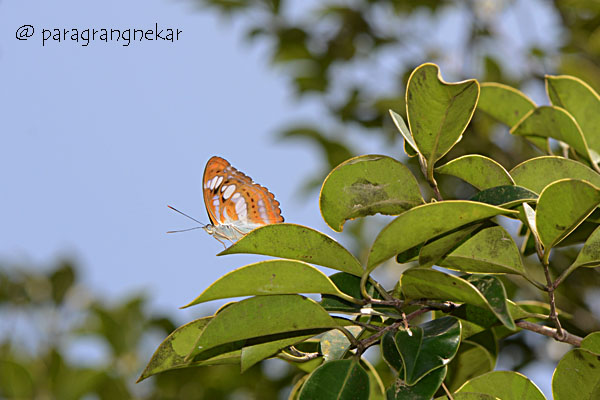
Hill-topping, a behavioral trait exhibited by male butterflies, wherein individuals fly to the hilltops and establish territories. Butterflies can be seen darting around tree tops and chasing each other, the strongest individual securing the highest vantage position. It is thought that this results in preference of such males by female of the species, although there is little direct evidence to support this theory. I for one, believe it to be a normal territorial behavior or a mate-location behavior where the chances of contact with the opposite sex increases compared to a forested valley.
Colour Sergeant-Male


This phenomena is usually seen in areas where there are sudden elevation changes in the terrain and are of conservation importance due to the concentration of butterflies in a restricted area.

The activity can go on for days and in some locations throughout the year. Various species of butterflies exhibit this behavior with Nymphalids (Brush-footed butterflies) and Lycaenids (Blues) the most predominant. Most butterflies found at such locations are fast fliers, uncommon and with a patchy distribution.
Large Gauva Blue patrolling his territory

In Goa, this behaviour has been observed at various location but past experience holds me back from disclosing these locations so as to avoid congregation of enthusiasts and photography buffs, which could be detrimental to the butterflies themselves.

Friday, November 4, 2011

Additions to birds of Goa, India


The link below highlights the presence of 3 birds not reported earlier from the State, the Slaty-legged Crake (Rallina eurizonoides), Spotted Creeper (Salpornis spilonotus) and Streaked Weaver (Ploceus manyar).
http://www.indianbirds.in/Archives2011_7.2.html

Nest in Sugarcane plantation in Keri-Sattari


Streaked Weaver - Male
The paper, as any scientific/peer reviewed paper would, contains the latest tally of birds for Goa which stands at 462. After the work by Heinz Lainer and his report on 420 birds, the Zoological Survey of India in 2008, through the Fauna of Goa series added 38 species. The report by ZSI is based on work of Heinz Lainer and the birds in Appendix (contains unconfirmed records of birds that are difficult to identify in the field or are frequently misidentified, or are contentious for various other reasons) were also included.


Though scientific papers would list the birds species from Goa as 462, personally I feel that the bird count of the State is actually 425, since only five species have been added after the work by Heinz, one by Paul Holt and four by I and Pankaj Lad.

This does not mean that the species listed as unconfirmed cannot be found in the State.While birding picks up as a hobby within the youth, the importance of keeping notes and observations seems to be on the wane. The need to emphasize on importance of regular observations, monitoring and above all maintain data over just weekend birding and photography is felt more as bird habitats fast shrink or deteriorate in our State.
 

Friday, September 9, 2011

Shravani Aitar


 (This article appeared in the magazine Shravan - Bhadrapad (2008) published by Vivekanand Environment Awareness Brigade. The prolonged rain-showers this year prompted me to post this article a little late in the season)
The monsoons have receded, with the season of intermittent rain-showers and sunny moments making its appearance. The denizens of the jungle are shaking their drenched coats looking forward to soaking in the sunrays. The birds are chirping louder while the lone caterpillar after feasting on the green growth of the monsoons has decided its time to be a butterfly. Adult butterflies are searching for those open spaces with sunrays filtering in to gather energy from the Sun God. It’s also time for those with the penchant for these wild places, experiences and the lesser-fauna to step out with extra vigour and explore their surroundings. A time to spend the hard earned Sunday to rejuvenate ones senses after a week-long rigour of the work place. I luckily happen to be one of those who celebrate their “Shravani Aitar” in the jungles of the Sanhyadri. Those who wish to join have to pack their bags on Saturday morning lest we waste time in the evenings for our journey into the wilderness. This Sunday the destination is Savri Waterfalls in Netravali.

Travel from Panjim to Netravali via Margao, Chandor, Tilamol, Zambhauli, Rivona, Colamb is an experience in itself. But the picture of the enchanting Savri falls is always at the back of your minds. Stop at the Budbudyachi Tali, pay your homage to Lord Narayan and proceed straight towards the Amba Ghat. We are on our way to Mangal, the village of the Velip community atop a hill. The road to the village is a steep climb and in a bad shape. In other months our vehicle could have taken us directly to the village but not today. The evening rains which greeted us in Netravali have made the road unmotorable and it’s advisable to walk the 3 kms to the village. It’s dark by the time we reach the base, and the Cicada’s have already started their orchestra. The frogs are still around though not as plenty as a few months ago. We hear one calling very close and it’s a pretty loud call. Sangam decides to locate the call and we join him in his search. It’s not an easy task we realise and then behold under a fallen leaf of a Kumbyo (Carea arborea) tree, we find the smallest frog that we have ever seen with his vocal sacs larger then himself. Omkar as usual goes into frenzy with his camera and gets some pretty good images. He, you will realise, is developing into a good photographer and a keen observer.
Cat Snake

The walk is actually a climb but keep a watch around, its time for the snakes to be out. The last time we were here, we saw the Common Wolf Snake near a pile of laterite stones. But the night is too young today and it will be some time later that the probability of seeing snakes would be more. The night is cool but you are perspiring and short of breath by the time you reach the village. Rohidas Velip is eagerly waiting your arrival and is a little anxious too since you are more than an hour late. He has made arrangements for our stay in the local temple and the common facility centre constructed by the community recently. Being a temple premise, the food is obviously vegetarian, but the flavour is out of the world and I assure you that you will eat more than you usually do, especially after the climb to the village.

Sleep comes naturally in this setting and as you go out to “answer natures call” before you hit the bed, you hear the rasping calls of the Leopard somewhere far away in the distant hills. You know you are in the Netravali Wildlife Sanctuary, the largest sanctuary in Goa covering an area of 240 sq.km. Do not waste time chatting or playing Carrom with the local boys in the adjacent house and sleep well. Rising early is the key for a good “Aitar” and that is exactly what we are here for.  

I wake you up at 5.30 a.m. and you will see the women already busy with the daily chores. You on the other hand curse me and for a moment wonder why you are here away from the cosy comfort of your bed. But the assurance of a promising day in the jungles will urge you to get prepared for the day ahead. Rohidas is at the doorstep with a wide smile to greet you. Do not forget to thank him for his hospitality as he thanks you for coming and invites you again. Offer money for the food that was cooked by his family but do not offer him anything else, lest he gets offended. A shake of hands or a hug on the other hand will widen his smile from ear to ear. The sky is changing shades as you walk down the hill and is showing various shades of blue.

Stop near the Netravali Panchayat and if you are lucky, the road side hotel will be open. Treat yourself to a hot cup of tea. The fragrance of the tea and the village atmosphere prepares you for what lies ahead. Turn on to your right from Netravali and park your vehicle where the tar road ends. You have arrived in the Savri village to begin the real journey.
The Draco

You may feel that the walk through the village may not be good enough. But think twice and keep a watch around. The Draco is best sighted here as it glides between coconut trees, in the dense jungles it may be difficult to sight. The red coloured spikes of the Clerodendron are like magnets to many butterflies especially the Blue Mormon and the majestic Southern Birdwing, the largest butterfly in India. Do not run behind these for a photograph since they are fast fliers. Patience is a virtue when photographing butterflies. Wait patiently but be alert and they will give you a chance when they settle for a few seconds to sip in the nectar from the flowers.

Walk along the water channel carved in the hill side and stop at the place where the locals have put a diversion bandhara to irrigate their fields. Look around and you will realize that you are in a paradise for butterfly watchers. The Common Hedge Blues, the Line Blues, the lone Angled Pierrot and the Ceruleans will always be there mud-puddling by the river side. The Soldier, the Grey Pansy, Tamil Yeoman and the Leopard will be basking on the shrubs by the river side and may be joined by the handsome Cruiser and the Red Spot Duke. It’s also the time for the magical Malabar Tree Nymph to glide in the canopy. You will see why they call this butterfly the nymph as it glides like a fairy through the trees. There cannot be a better sight than this and the image will transpire in front of your eyes everytime you close them and think about the butterfly.

You may have ignored the dragonflies and damselflies before but not today. One, because they are too many to ignore and two, because I am with you. I have grown to love these creatures over the last few months and have been able to explore their world to be astonished by their diversity. Omkar has caught this bug too and is growing confident with every passing day. Ignore his antics while trying to photograph the rare Pied Reed Tail, let me help you in identifying the common ones. The tiny Stream Ruby on the rocks is not uncommon and a wonderful sight when it flashes the brilliant red in its wings. Do not mistake the one sitting next to it as a different species; it is the female though it looks completely different. The adjacent vegetation is a great haunt for the Black-tipped Forest Glory. It is all over the place but somehow knows about your presence and all your attempts to get a good close up image will be in vain. Waiting patiently will help but we need to go ahead.

Walking in the river bed has its own charm. Do not follow those who jump over rocks. Wade into the water and experience the refreshing feeling unmatched by anything else. The next bend in the river will bring you face to face with my most loved waterfall…. The Savri. No other waterfall I have seen falls with such gusto with its waters having a musical tone to it. Take a dip but venture into deeper water only of you can swim. The cold waters are not for the faint hearted as you will miss a breath at the first contact with your skin. But I am sure you will not miss the chance. For those who want to dip only their feet, keep them still for the fish to clean them of dead skin and debris.

Being one in the jungle can lead to loosing track of time. We can’t afford to do that. Need to get back to the office and the daily routine tomorrow. The thought is unsettling. I do not know about you but the dip in the crystal clear waters of Savri will keep me going for the week as I look forward for the next “Aitar”


Friday, July 15, 2011

ENTER THE DRAGON

(This article appeared in Parthenos (April-June 2011) - A newsletter of DiversityIndia)

I have always loved Entomology. If not for my choice of the University, I would have earned a Masters in Entomology instead of Plant Pathology. The interest begun with Honeybees as our Professor, Mr. Kulkarni taught us Apiculture during the undergraduate days. Even as some of my friend found it tough to remember the scientific names, let alone spell them correctly, I found myself at ease with the whole business. The course taught me the applied angle of Entomology but the seed of Taxonomy was sown somewhere deep within.

It was sometime in 2008, 9 years after I earned my Masters Degree and after my book on butterflies was being received well that I decided to take insect taxonomy seriously. The Phylum Insecta is so vast that one lifetime would be insufficient to study a single Order. Butterflies or Order Lepidoptera seemed the obvious choice but my selection of the Order Odonata, which consists of Dragonflies and Damselflies probably, has its origin in Amboli, the village where my interest in wildlife can be traced. As a child brought up in a village setting, I was witness to the game of catching dragonflies and tying their tails with thread. I say witness, since I never found the game amusing, one, since I felt pity for them and second since I knew they bite back. I did catch them though, but the smaller ones and observed how they tried to bite anything that was brought close to their mouthparts. But what caught my imagination where those which flew in thousand over open field and never seemed to tire. There would only be few on one day and on another the whole open field would be swarming with the reddish coloured dragonflies. It was fun to see the Small Green Bee-eater hawk them in the air, beat them against the wires, break off their wings and swallow them. Numbers would be so high on occasions that a few would get crushed under passing vehicles. Now I know they are called the Wandering Gliders (Pantala flavescens) and rightly so.
Long-legged Marsh Glider (Trithemis pallidinervis)

That was a very long time back and after graduating I had the opportunity of being associated with the World Wild Fund of Nature (WWF) as a Volunteer and took pride in sharing my knowledge of biodiversity with adults and children alike during many of the Nature Trails and Camps. One hurdle though was the identification of Odonates. With no guide readily available, like the ones for Birds and Butterflies, all the different species remained just Dragonflies and Damselflies for me. By the way somewhere in between I learned that the smaller cousins of the Dragonflies are called Damselflies.

It was my Nikon D80 brought in 2006 that changed things for the good. Armed with a 105 mm Macro lens, I started photographing Dragons and grew to genuinely appreciate their amazing variability. With the collection growing and the need to know their identity made me look for people and sources which would help in identification. The world of the internet was a mine of information and within a short time I had names for most of the photographs. But something somewhere was amiss. I felt like the school kids accompanying me on trails and accepting every word that I said or all identifications that I made without ever questioning their authenticity. That is the time I decided to identify Odonates myself. The seed sown in the college days had finally germinated.
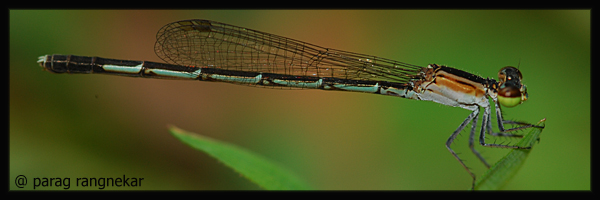
Agriocnemis pieris

What has followed has been a great learning experience full of joyous, proud and frustrating moments. It is ironic though that the basic work done by the British of cataloguing the biodiversity of this Country still remains the most widely used literature for identification of lesser fauna. The three volumes of The Fauna of British India on Odonata by Fraser is a monumental work and one wonders how anybody could dedicate so much time and energy to classify organisms which even in today’s world are not considered significant enough.

Trumpet tail (Acisoma panorpoides)
I also became conscious that the State of Goa has only 39 species documented by various researchers and here I was holding images of more that 70 species. I wonder how in the world we will ever conserve anything that we do not know exists in the first place. The gaps in our knowledge of our surrounding environment are so vast; it makes me wonder what are we searching for on the Moon and Mars?? I felt sorry that very few students and researchers are interested in Taxonomy, which actually is the brick on which the building of science stands. As I explore the interiors and water bodies of Goa in my search for new Odonates, I realize how important Taxonomy is not only for these winged predators but also for all the wide variety of biota that we have around us.

I will continue on my quest, which I am sure is not going to be any easy one, but hope that more and more youngsters take interest in  lesser flora and fauna of this country with a view to aid in their conservation.